Pages

Sunday, May 6, 2012

How the magic was nearly lost at the Jaipur Literature Festival

The Jaipur Literature Festival this year exhibited true Indian ethos – it had the melodrama of a masala Bollywood movie, the chaos of a Big Fat Indian Wedding and the cliffhangers and dramatic tension of the Mahabharata. And that wasn’t the literature being discussed, but the event itself.
Last year the controversy was over the public spat between Hartosh Singh Bal, political editor of the magazine Open and British author William Dalrymple, co-founder of the event, with Bal accusing Dalrymple of deliberately tying the event to the British literary establishment.

This year it was Salman Rushdie’s proposed visit which cast a shadow over the event from the start, with many speakers expressing their outrage during their sessions at the attempts by certain Muslim groups to prevent Rushdie’s trip and the same issue dominating questions from members of the audience in such sessions, which had no connection to him or his works.
This culminated in the front lawns of Diggi Palace being crammed with people and police on the final day and a media scrum anticipating a video link with the author of The Satanic Verses. Even at 3.45pm that day, the time when he was due to appear, the audience were told a decision had not yet been reached as to whether he would appear, leaving everyone, myself included, on tenterhooks.

Most of the time people had to stand outside the Durbar Hall to listen to the speakers.
Shortly before 4pm, the owner of the Palace, Ram Pratap Singh, announced that people were inside the property intent on committing violence if the video link went ahead. Organiser Sanjoy Roy promptly burst into tears and we were told that people were “marching on Diggi Palace” conjuring up scenes of Birnam Wood marching on Dunsinane.  All the emotions, drama and tension of Indian fiction were on show.

There were similar scenes of chaos too when Oprah Winfrey arrived on the third day of the event. Queues stretched for miles down the road outside the venue and crowds trying to enter surged against a police barricade, but the authorities had closed all the entrance points because the venue was overcrowded inside.
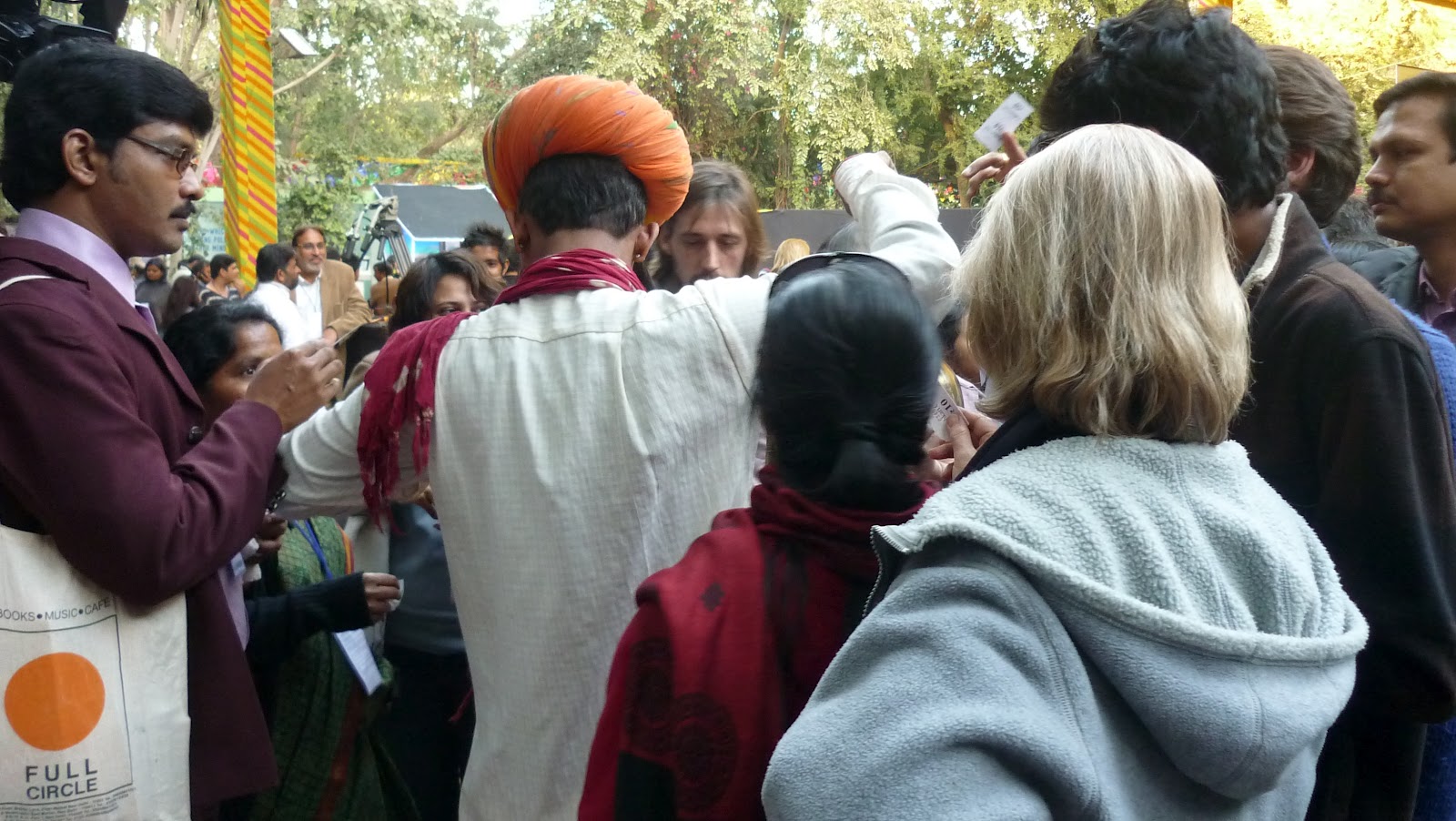
The festival was far less relaxing this year with crowds everywhere.
These knife-edge dramas were bad enough but poor crowd control throughout the five days meant the festival almost lost its special vibe this year.

Even on the four days when Oprah Winfrey was not there, it was overcrowded, you could not get into see many speakers and there were tiring long queues for toilets and the coffee stands. 

The festival was, seemingly for the first time, packed with school children and gangs of college students and a variety of other people, many of whom could not speak English, when the sessions were held in English. 


Coca-Cola umbrellas added to the "commercial" atmosphere. 

Even the central area in front of the Durbar Hall was packed.


Overcrowding was a common complaint among the educated Delhi and Mumbai intellectual types who frequent the likes of the India Habitat Centre in Delhi and Prithvi Theatre in Mumbai and who descend on Jaipur every January.

A typical scene inside Mughal Tent. You were very lucky to get a  seat. Many people sat outside and listened through the tent.
One university lecturer from Delhi turned to me in the queue for the toilets and said: “I asked the guy on the seat next to me whether the seat was vacated and he couldn’t understand that simple question. If he couldn’t understand that, how can he understand what is being discussed? There are people here who have come just because they have seen it on the news with all the publicity it has generated and they haven’t read anything and don’t have a clue what is going on. This festival is meant for a more mature crowd.” Since the tickets are free and there are no entry requirements, indeed anyone can attend - something the organisers have till date been proud of. 

As I stood outside the Ben Okri session, straining my ears to hear, a man who looked like a software geek asked me: “What topic is it?” “Ben Okri,” I replied. “But what topic is that?” he asked. “Ben Okri,” I responded. “But what does that mean?” He said. “He is the Booker Prize winner,” I said. “Oh I better take his picture,” he said and got out his digital camera.
It was impossible to get anywhere near the Ben Okri speech.
Scenes outside the Durbar Hall.

People pushed and shoved outside the Durbar Hall.

So, having Oprah Winfrey on the programme was, in my view, not the best idea. The venue is very small and cannot handle the crowds she attracts. I first went to the Jaipur Literature Festival in 2010 and the beauty of it then was the informal intimate atmosphere, the fact the authors were accessible and freely mingled in the central yard with the public and indeed the free steaming chai served in earthen cups from huge bronze pots by men dressed in brightly-coloured Rajasthani turbans. I remember chatting to William Dalrymple and Mark Tully while waiting for a cup. This year conversely the authors were in a segregated area and not accessible. The one time that Gulzar ventured into the public area, he was mobbed. Besides, the tea cost Rs10 and every time the vendor turned up with it he too was mobbed. 
Even the Rajasthani tea vendor was mobbed whenever he appeared.

People pushed and shoved just to get a cup of tea. The vendor was visibly stressed out by the crowds.

There was an array of shops run by fairly aggressive sales people, Coca Cola and Café Coffee Day stalls dotted around too. It was becoming commercial.

The Coca-Cola stand

Cafe Coffee Day stalls were everywhere

The  shopping parade

The festival was flooded with police as well for its five day duration. This was to prevent a terrorist attack following the threats against Rushdie and the organisers. These police spent most of the time in groups, taking up the limited chairs around, drinking chai. Occasionally they even sat in on the literature speeches and fell asleep.

Police are caught on my camera snoozing during a speech

Police were everywhere reading newspapers and drinking chai 

But not all the magic was lost. There were still plenty of opportunities to bump into friends you were not expecting to see from Delhi and Mumbai, to strike up new friendships with other literature lovers, to chat to anyone you like without appearing odd and even to lobby literary agents and publishers in the festival cafes with your book ideas. Apart from that, all the speakers, such as playwright Tom Stoppard, author and speaker Deepak Chopra, author Mohammed Hanif and Outlook editor-in-chief Vinod Mehta, were, unsurprisingly intensely engaging and stimulating.

However, now great thought needs to be given to the future direction of this prized festival, which is listed in the Debrett’s social calendar. Should it return to being an informal gathering of intellectual arty types at Diggi Palace or should it move to a larger venue and attract the masses but at the cost of losing that special magical vibe? 

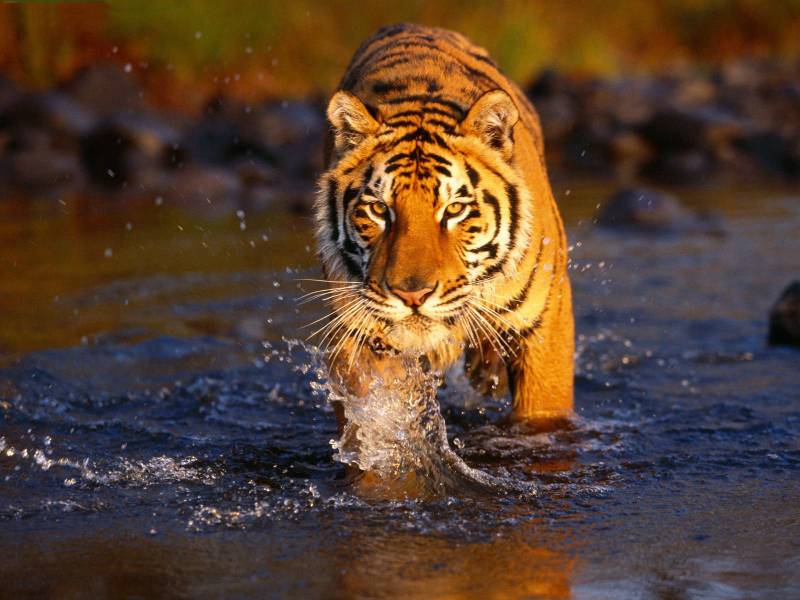
The tragedy of the Bengal tiger in India

A renowned TV cameraman came to the Brympton Literature Festival in Somerset recently to speak about the plight of tigers in India.
Michael Richards is the cameraman behind "Tiger: Spy in The Jungle" ( a BBC TV documentary narrated by David Attenborough) as well as the book "Tigers", which he wrote with Hashim Taybji.
The festival, the first ever to be held, took place inside the majestic and quirky Brympton House, a privately-owned 13th Century grade I-listed manor house in Somerset. It is occasionally hired out for weddings or films but otherwise remains a private residence.  It originally belonged to various aristocratic families but it was sold in 1992 to the present owner, who is a judge and his wife. 
Richards, one of the speakers at the literary event, is one of the world's leading experts on wildlife who works for an independent production house in Bristol which makes programmes for, among others, the BBC.
He spent three years inside Pench National Park in India filming the tigers and his talk was about how he made the famous documentary film, "Spy in the Jungle."


The three series of the film were first broadcast on the BBC in 2008. They  followed the lives of four baby cubs, two male and two female, growing up to be adults in the Park.


The production team used motion sensitive cameras, hidden in logs and rocks, triggered by moving wildlife as well as remotely-controlled cameras carried by elephants on their trunks and tusks, known as trunk-cams and tusk-cams, so they could catch the lives of tigers, not usually caught on film. The tigers were oblivious to the elephant as they do not perceive them as a threat so they went about their daily business as usual, so it all got caught on film - something that would never had happened had humans done the filming. The human crew instead watched the images and controlled the cameras from the tops of other elephants nearby.


The spy cameras happened to catch four 10-day-old baby cubs playing with their mother and the crew decided to follow them as the core thread of the documentary.  It showed them suckling their mother, playing together, relaxing in water, learning to hunt and having to face the dangers of the jungle. One of the elephants they used to film the tigers with also gave birth in the middle of the film!

Apart from capturing on film a range of other extraordinary wildlife such as sloth bears and langur monkeys, the cameras also happened to capture illegal activities such as rural people and cattle illegally bathing in waters in the national park, Richards said.  Did the Park staff turn a blind eye? It is very concerning.
The truth is that humans and tigers cannot coexist as the unsustainable habits of of humans further degrades the tiger habitats.


Richards also spoke about how hotels were being constructed just outside the Park too, which were also destroying the tiger corridors. Fences were being put up around areas that tigers had previously used to migrate through. Tigers need corridors to move freely between different tiger habitats in search of mates to spread their genes. These corridors are especially crucial for male tigers who need to establish their own territory to avoid being killed by another male. These corridors can play a crucial part in preventing tigers from going extinct, which could easily happen if more is not done to protect the tiger in India. Why is planning permission being given?


Poaching is another massive problem that tigers in India face as their body parts are used in traditional Chinese medicine, even though doing so is illegal and there is no scientific evidence to support the idea that tiger skin and bones can cure anything. Ninety-five tigers are said to have been killed across India in 1994, 89 tigers were killed in 1997, 36 tigers were killed in 1998, 72 tigers were killed in 2001 and 35 tigers were killed in 2003. Are Park staff turning a blind eye?
The number of tigers in India has halved in the past 10 years. 

But Richards explains that the brutal slaughter of tigers began not with the Indians, but with the British - during the British Raj - something for the Brits to be ashamed of. 


Apparently there were more than 100,000 Bengal tigers in India during the British Raj but hunting them became a prized sport of off-duty British Army Generals, who would go hunting with the Maharjahs. Jim Corbett, a British Indian army colonel, is one of the most famous tiger hunters, who killed the Champawat Tigress which had killed nearly 500 humans. 
Between 1997 and 2006, Bengal tigers in India are thought to have lost more than 50 per cent of their habitat. Now there are believed to be less than 1,800 tigers in India and less than 3,500 in the world. This is a far cry from 100,000 a century ago. Indeed mining, dams and road building are seriously interfering with their natural habitat as trees get felled and the dense forest they require to live in shrinks.

Richards also  spoke about the challenge of getting the millions of Indians who scrape a meagre living at the bottom of the social ladder the slightest bit bothered about saving the tiger, when they have so much to worry about in their own lives. 


When I was in Mumbai recently, I visited the apartment block I had stayed at in Bandra. There was not a cat in sight. That was mainly because I had brought my two domestic short-haired Indian cats back to England. The other Indian strays, who I had tried to look after, who lived outside, had disappeared. The building, by the way, was suddenly eerie and soulless.


One wonders what an India without its national symbol of the tiger would be like? The word soulless comes to mind. Will India allow this to happen?  It would be ironic if India, one of the world's fastest-growing economies, manages to destroy the tiger, its unique national symbol, through a rapid and  programme of deforestation and industrialisation, in a ruthless attempt to be come a global economic power.

Wildlife expert George Schaller once wrote: "India has to decide whether it wants to keep the tiger or not. It has to decide if it is worthwhile to keep its National Symbol, its icon, representing wildlife. It has to decide if it wants to keep its natural heritage for future generations, a heritage more important than the cultural one, whether we speak of its temples, the Taj Mahal, or others, because once destroyed it cannot be replaced."


Wednesday, December 7, 2011

The ennui of blogs that bash India

I recently read a blog by a NRI (non resident Indian) living in the US bashing his homeland, India.

This particular blog has done the rounds of the Internet and Facebook, and sparked such debate that the New York Times, which originally published it, has been forced to do a story on the outraged responses to it. The blog can be found here http://india.blogs.nytimes.com/2011/10/22/why-i-left-india-again/

It is written by an NRI called Sumedh who first left India to live in the USA in 1996 and then returned 10 years later in 2006, seduced, he says, by a "Thomas Friedman India", presumably referring to the shiny urban India of call centres described in Friedman’s 2005 book, ‘The World is Flat’. Sumedh first moved to the US before ‘Shining India’ had emerged. Sitting in the US sipping a Starbucks, no doubt, he was clearly seduced by a new perception of India emerging as the next global superpower. He wanted to return to find that India, which in his view, was a more palatable version of the India he had left. He writes in his blog that he returned in 2006 prepared for an India that was “like the flight’s Indian vegetarian meal;  visually familiar but viscerally alien…an India that offered global companies, continental food, international schools and domestic help.”


Bollywood films by the likes of Karan Johar no doubt helped build up this image of a fun, modern, funky, shiny clean India and newspaper articles in American media about the India growth story probably precipitated his decision. Of course the shiny  India he had read about in the USA did exist – but only in five star hotels and urban centres – and another less successful, less organised but perhaps more endearing India was also still very much there, less reported on in the American media, one he had hoped had faded, but still very much in existence.

Two years and 10 months in to his stay in this New India, he decided he hated it, packed his bags and returned to the US and his blog is all about the reasons why he couldn’t stand New India. He blamed India for his inability to adapt to life there and not himself.

The blog was offensive to many people. One of his most maligning claims is that his stint in New India had made him inhuman and soulless; he claims it turned him into a smug person who, like all rich Indians (according to him), dehumanised the labour classes. He says he started to hate himself. He had “regressed,” he said. “I hated what I was becoming,” he wrote.

It is fallacious to think that a country can change you and make you become something else or a worse individual than you already were. It is a twisted logic. He became what he became because he chose to become that. Nothing stopped him becoming the next Mother Teresa, but he chose not to.

Here are some of the aspects of India which he said he hated in New India and were the reasons for his return to California in 2009:-

1)      The maid system. He said that by the end of his stay he “probably spent more on pizza than [his] maid.” This comment alone demonstrates his complete lack of understanding of how India works and how he was, in an Occidental imperial way, trying to impose his Western viewpoint on the way India works. Anyone who has an ounce of understanding of India, appreciates it is part of the East, not West, and has its own way of functioning. (Everyone knows for example that Mumbai has a fantastically organised, but seemingly complex way (to the Western eye), of delivering packed lunches known as tiffins to workers; everyone knows that the washing at Dhobi Ghat is done in a more efficient manner than dry cleaners in the West could imagine but to the Western judgmental eye it appears chaotic, even though it is in fact highly efficient.) There is no global law that states that every country has to function how the US does. You do not judge a maid’s pay in India on her wages alone. It is far more complex than that, as is most of what happens in India.


For starters, to my knowledge there is no law in India which regulates the wages domestic workers earn or sets a minimum wage. They are part of the so-called disorganised sector. Therefore most Indians pay maids the going rate, whatever that is, after inquiring about it. The maids themselves generally set this rate in an informal manner by demanding specific wages when you try to employ them.  No maid is forced to work for anyone and they refuse to work for you if you do not pay them what they want. But the compensation does not stop there. Everyone I know, gave their maid at least a month’s salary as a bonus at Diwali, with probably saris and sweets on top. Others gave bonuses at Christmas as well. Many Indian families I know regularly bought their maids clothes and always paid for their medical treatment. One Indian lady I know had to move to the US for a year and paid her maid an annual salary anyway even when she was in the US and the maid wasn’t even working for her - as a gesture of gratitude and loyalty.  It is standard practice to increase the maid’s salary every year and most families let them take a month off to visit their village in May and still pay them!

 I think it is extremely naïve of NRIs or expats to turn up in India, hear what the salary is, compare it to what a cleaner would get in the US or UK for the same hours and then brand it as slave labour. That is not how it works. In any case, there is a completely different cost of living in India compared to the US so you would not expect to pay a maid there the same wage. Yes, maids one day might join the organised sector of work, when minimum wages are set, but currently they are in the disorganised sector meaning they don’t pay income tax etc…The matter is not black and white and a maid’s pay cannot be compared to the price of a pizza. Yet, throughout his blog, Sumedh demonstrated a surprising Western superiority complex over the way India functions. He also referred to an incident when his friend’s children got amoebiasis (posh word for food poisoning) and he “thought” (note: did not even know) they got it from “the maid” so from that point onwards he and his wife “separated the dinnerware” the maid used. That is discrimination at the extreme! I don’t know any Indian employer of domestic staff who did that. My maid often used my cups and plates and I thought nothing of it. This writer is referring to what he did (that was discriminatory) and then inferring that all Indians do this. It is as absurd as an Indian moving to Britain and beating some men up outside a football match saying “ All Brits do this.”

2)      He said that at one point his driver asked him for a Rs 500 loan (£6) to attend his grandmother’s funeral and he “brusquely” refused implying that all rich Indians “refused” loans to their drivers as well. “It only encourages them to ask for more; besides, they’re all liars,” he wrote, expressing his personal view of drivers, suggesting that was how all rich Indian felt about their staff. Wrong!. All the Indians and expats I know who had drivers regularly lent them money when required and this was considered part and parcel of hiring the driver. The driver received far more than a salary alone, with medical costs etc thrown in and the drivers wages were within the scale of things in India, quite good. Most of my friends were beholden to their drivers, rather than the other way round, usually leaving parties early so their drivers could get home to their families, giving them time off regularly and paying for them to attend funerals. To refuse a loan for that is simply disgusting and if it was me, I would not even expect the money to be repaid and would just give it.

3)      He describes how he also had a road-rage incident:. “I verbally abused a hawker who was blocking the road. I’m not going to let bullock-cart India make my daughter late for her school admission test. The hawker glared but scampered away, the road cleared, and, as I walked back to my car, I saw something new and disturbing in my driver’s eyes: respect,” he wrote. The fact that his driver’s reaction to his violent outburst was mere surmise on his part, is bad enough. For all we know, the glint in his driver’s eye was anger towards him, not respect. But either way, to refer to a hawker as “bullock-cart India” is extreme discrimination and then to put his child’s school admission test above the right of the hawker to common courtesy says more about him than it does about India. I have seen road-rage incidents occasionally happen in the UK and in India but only by angry fired-up people. Not everyone engages in them. In India, I found most people to be impressively patient and it was patience that I learnt in India, rather than road-rage.

4)      He also wrote about his ability to perfect “reflexive, addictive and tragically accurate placement of other Indians into bullock carts, scooters, airplanes and who knows what else”, the issue of “caste” and getting tips on “keeping his maid in her place.” It was, in short, grotesque. I never “kept my maid in her place” and nor did any Indian I know. My maid became my best friend, we discussed my love life and she grew to adore my cats. When I left India I gave her everything in my flat for free. But that is not unique – it is what every Indian does. I know of Indian children that have grown to love their maids like members of their family. Yes, there is a class system in India, like there is in the UK. But it is nowhere near as inhuman as Sumedh made out. And if he had wanted to write about that and how socially mobile or not the Indian class system was, his blog just skimmed over the surface and barely touched on it. That indeed might have made an interesting read. I would happily rather read a piece on caste and the class system in India based on interviews with maids, drivers  and watchmen rather than the single view of an NRI with a Western mindset unable to integrate in India describing his ill-informed impression of the matter. The caste system is anyway almost a nebulous concept, talked about more in the West than it ever is in India. It has little relevance today as a) many Brahmins (once the highest caste) are now penniless and unemployed, like British aristocrats and b) many of the lower castes now benefit from positive discrimination in jobs and education.

I am sure I mixed with Indians of all castes and yet no one knew anyone’s caste, it was never discussed and it did not affect anyone’s promotion in the work place or entry to a club or anywhere. India is not that behind, thank you. The practice of untouchability in India was outlawed in 1950. It is, in my view, one of those subjects, like earthquakes and poverty that Westerners love to use when discussing India, to make themselves feel better.

Sumedh failed to say anything he liked about India or to show any deep insight into the workings of India, a massively diverse and complex country . All his blog did was prove how distant some NRIs are from their actual Indian roots, and how many of them have lost the connection completely and are now as native as the natives in the countries they have moved to.

A British NRI friend of mine was equally revolted by the NRI piece as me. “I could predict what we was going to write before I read it. This is the same old trite foreigners have been writing about India for the past 40 years and now the NRIs are doing it. I am an NRI and I love India and Britain. I am as happy having a chai at a chai stall as fine tea at the Taj or the Ritz. I can do both and enjoy both. I don’t understand what all the fuss is about,” he said. I met another NRI living in Germany the other day, a wise old man in his 80s. He said to me, "When you visit India you cannot go there expecting the same life as you have in England. You have to put all that aside and embrace India for what she has.” He was right. Similarly so does an Indian coming to Britain.

So, in my humble view, if you want to make comments on how awful another country is to live in, first survey a million residents living in it, then present the picture. Do not make sweeping statements based on your own single, subjective, non representative experience.

Monday, October 31, 2011

The ongoing struggle of the adivasis (tribal people) in India


Swanky shopping malls, restaurants selling chocolate samosas, cafes promoting lattes and cinemas screening 3D films are what make up urban India today. 

Riding on an unprecedented boom, more Indians than ever have got large disposable incomes and are willing to splash out on everything from washing machines to BlackBerries and sushi to Margaritas. 

But while that is life in Indian cities, there is a completely different scene in the dense forests where nearly 100 million adivasi (tribal people) live. There, environmental destruction and bloodshed can be found, as India’s indigenous people are being displaced to make way for steel plants, roads, factories, mines and refineries.

Despite having followed a sustainable way of life for thousands of years farming, hunting and gathering, these tribes, the “refugees of India’s ‘progress’” as Booker prize winning novelist Arundhati Roy describes them, face a bleak future. Many are engaged in battles to stop their land, lives and livelihoods being taken away because beneath their homes lie India’s richest natural resources, namely uranium, bauxite, limestone, coal, marble, and iron ore, worth millions of pounds. Meanwhile the ecosystem is getting destroyed as forests get bulldozed for profit from heavy industries to fuel the Indian dream.

Orissa has more than 50 per cent of India’s bauxite reserves, the raw material for aluminium, worth a staggering £2 billion. 


But the fallout is everywhere. For example, 100 villagers from the Majhi Kondh tribe were displaced when a one million-tonne alumina refinery opened up in Lanjigarh in 2008.

The villagers were forced to leave their traditional mud huts and move into concrete resettlement colonies on the edge of the refinery. Now without land for grazing or forest produce, many have gone back to the hills.

“They had no means of making a living. They were sitting on concrete steps with nothing to do,” says Dr Jo Woodman, campaigner for Survival International, which successfully campaigned against proposals for a six-fold expansion of the Vedanta-owned refinery. The Ministry of Environment and Forest blocked the mining giant's plans in 2010.

40 Dongria Kondh from several villages blockaded the road to the proposed mine site, holding banners  
© Lindsay Duffield/Survival
Kumpti Majhi, a member of the Majhi Kondh tribe, explains: “We do not need jobs or money. We want to live here as we used to, peacefully. If the mountain is there, we have water, clean air and fruit. There may be some development, I may benefit, but will my son and my grandson?”

Many do not possess paper titles for their ancestral land, so do not even get any compensation if resettled. Even if they do, the money is quickly spent and does not provide a sustainable source of income, Woodman says.

But Vedanta also hopes to mine bauxite at the nearby sacred Niyamgiri Hills. No villagers would be displaced if this open-pit mine went ahead. But Woodman says the mountain is perceived by the Dongria Kondh tribe as the seat of the gods and they do not want to “sell it”. 


Dongria Kondh girl playing on a swing in the Niyamgiri Hills, India
 © Survival
“They graze animals on top of there, worship there, farm it and collect medicinal plants from it,” she says.


Although these plans were rejected in 2010 by the Ministry of Environment and Forests, the case has now gone to India’s Supreme Court.

However, Vedanta Aluminium Ltd claims it is improving the standard of living of the tribes. On its public blog, it writes the region will “stand to gain from infrastructure development including power, access to primary education, quality healthcare services, employment generation, diversification of the agrarian economy, thus accelerating the process of economic development.”

But Woodman says: “The Dongria tribe doesn’t want anything from these people. For a community like the Dongria you can’t compensate the deep spiritual connection they have to their land. They don’t want the mines to go ahead.”


Dongria Kondh boy Kalia stands in front of the Niyamgiri hill range.
 © Lewis Davids/Survival
As a result of total despair, many adivasis have, controversially, turned to the Maoists, an armed insurgency trying to overthrow the Indian state, for protection.

“The state government keeps giving the green light to take away their lands and their ability to resist under normal democratic means is fruitless,” Woodman explains. “The adivasis feel extremely frustrated which fuels the Maoist insurgency and is why a lot of Maoists are adivasis.”

Author of The God of Small Things Roy has also taken up the adivasi cause, claiming that India’s growth rate is built on “taking land from the poor.”

In her recent book, Broken Republic: Three Essays, published by Hamish Hamilton, she writes: “The armed struggle that has broken out in the heartland is not the first, but the very last option of a desperate people pushed to the very brink of existence.”

The Indian novelist, who has spent time with Maoist guerrillas in the forest, says: “When a posse of 800 policemen lay a cordon around a forest village at night and begin to burn houses and shoot people, will a hunger strike help? When people are being brutalised, what ‘better thing’ is there to do than fight back?”

But the violent conflict has so far caused more than 10,000 deaths on all sides with Maoists, civilians and the police all getting killed.

Approximately 27 per cent of India’s coal reserves are in Jharkhand, another state where mining is rife. Robert Wallis, an American photojournalist, ventured into Hazaribagh and Ranchi districts in 2006 and 2010 to witness first-hand the impact of open-cast mining on the adivasi way of life.

“As far as I was aware, the adivasis I spent time with had no connections with the Maoists," he says. "They were trying to use art as a means of resistance, and to preserve their traditional culture against the onslaught of mining.

 “The western media always wants to talk about Shining India, that image that all Indians aspire to – being middle class, shopping malls and Tata cars,” explains Wallis. 


“While this has been true for a minority of the population, it’s not for the majority, especially not for the adivasis who are suffering to enable Shining India to come to big cities. It is wreaking destruction on their lives,” he says. 

His photos, which were shown at The School of Oriental and African Studies in London in 2011, include pictures of adivasis in their traditional mud or leaf homes, then in urban slums and resettlement camps, where they have been forcibly rehoused.

He describes the latter as "listless". They have "no connection with their environment anymore" and cannot continue their ancient traditions such as painting their mud homes or worshipping nature, he says.

Dispossessed of their homes and heritage and without work, they often ended up scavenging on the peripheries of mines, his captions state. One picture shows a couple from the Birhor tribe returning home having caught nothing as there are no animals to hunt owing to the destruction of the forest habitat.

"The result of these industrial projects is of no benefit to the tribal people as the electricity generated is going to places like Delhi and the iron ore is going to China" he adds.

"The whole landscape is changing," he says, explaining how one minute he photographed traditional tribal villages as of yet untouched by mining, the next he shot the remains of whole villages that had been wiped out and left crumbling on the edge of open-pit mines. He also saw roads dug through remnants of huge swathes of forest that had now vanished.

"My belief is that the only way India will really prosper if it protects its traditional way of life - some people may call adivasi life primitive, but it's sustainable," he adds.

 “It’s not that we believe that the minerals should be left in the ground,” argues Woodman. “We appreciate these areas are rich in reserves and it’s inevitable India is going to want to extract them but it’s recognised international mining practise that you don’t proceed with a mine against the express wishes of the local community. The mining companies need to listen to the community and respect their wishes, rather than thrashing in and not doing any kind of proper consultation. Of course there is plenty of land that should have industrial development because it has been ruined for agriculture,” she says.


Dongria Kondh children inherit their ancestor's jewellery at a young age, part of the history that ties them to their sacred homeland in the Niyamgiri hills: © Survival


The Indian Government is acutely aware of the ongoing crisis and is urgently trying to get it resolved. A subcommittee of  The Ministry of Environment and Forests and the Ministry of Tribal affairs recently produced a detailed 284-page report,  named 'Report of the National Committee on Forest Rights Act', ,which following a lengthy investigation into adivasi rights in forested areas of India. 

The findings of the report, published in December 2010, matched what NGOs have been saying. It found that adivasis, 92 per cent of whom live in forests, had frequently been illegally removed from forest land without any verification or recognition of their rights, in violation of the Forest Rights Act 2006, which was enacted in 2007 through the Ministry of Tribal Affairs, to correct the historic injustice done to forest-dwelling communities, an oppression which commenced in colonial times. 

The report also admitted that the rights of forest dwellers were indeed being ignored and tens of millions of them had been displaced from their homelands to make way for development projects such as mines, power plants, irrigation, dams and roads.


 It said the Forest Rights Act had been frequently violated, despite directives from the Centre to the contrary. The report discovered that the forest dwellers were generally poor and illiterate, either unaware of or unable to negotiate their rights and so huge swathes of land were being passed over to industry "unchecked."

 The report blamed complete confusion and chaos at a local administration level, blaming local officers for having no knowledge or understanding of the FRA Act.  It called for "an urgent need for the involvement of human rights organisations" in the matter and called for swift  action to enforce the Forest Rights Act was being implemented at a state level and for action to be taken against those who violated it and for roads, electricity and hospitals to be finally built in forest areas. © Naomi Canton 2011

India and China set to rule this century


India and China are set to dominate in a new post-western world but “that did not necessarily mean that the USA and Europe have had it,” the last governor of Hong Kong, Chris Patten, has said.

Patten, now Chancellor of Oxford University, made the remarks in a speech he gave at a recent alumni weekend, held by the university.

Chris Patten speaking at Oxford
Lord Patten of Barnes, famed for handing back the sovereignty of Hong Kong to the People's Republic of China in 1997 marking the end of British rule, told the audience of Oxford alumni that there had been a major shift in the global balance of economic power and that India and China would dominate this century, creating a new global hierarchy dominated by the East.

In his speech, ‘What next? Surviving the 21st century’, based on his namesake book, he spoke of a “fin de siècle” mood pervading America and Europe. But he said he did not accept that the world today was more dangerous than before, pointing out that at the time of the 1962 Cuban Missile Crisis, which coincided with his first term as a student at Oxford University, “the world appeared to be teetering on the edge of nuclear Armageddon.” I don’t think that things are as dangerous today as that,” he added.

While the world knew what it needed to do in order to survive, at present it appeared to “lack the political leadership and international political capacity to rise to the challenge,” he claimed. “We know what needs to be done from the Middle East to climate change. We know the sorts of things the international community should be doing in order to find a sustainable solution,” he went on.

The former Conservative MP and European Commissioner warned that the world population, which increased fourfold in the 20th century, was set to increase from 6.9 billion by a further 2.1 billion by 2050 and the majority of that increase would be in very poor countries, most of which already faced political instability and considerable environmental stress. “The only rich country in the top 10 where population is increasing now is the USA,” he added.

Speaking at The Sheldonian Theatre, where Oxford’s matriculation and graduation ceremonies are held, Patten said we can expect to see an explosion of growth in the numbers of people living cities (which increased 13-fold in the past century), especially in China (where it’s reckoned a billion people will live in cities by 2050). He said we could also expect to see an increase in energy consumption which had already increased 13 fold in the past century because industrial output had increased 40 times and also increased water use (which had increased ninefold in the past century), including possible conflict over water resources between India and China in the future and increased carbon monoxide emissions (which had already increased 17 times in the past century.) All of this was “posing probably the biggest issue for diplomacy, arguably since [The Treaty of] Versailles,” he claimed.

He then spoke of the India growth story and visible power shift already taking place. India has several multinational companies with global brands against which other companies benchmark themselves like Tata, Reliance and Infosys, he said.

“India now invests more in the UK than the UK invests in India,” he added.  He said by 2040 India would probably have the largest population in the world and Chinese pensioners would be the second largest.

China is currently the second largest economy in the world but, by the 2020s, China would overtake the USA to become the largest economy in the world, Patten said.

“It’s a world you can very properly describe as post western. Asia no longer has to define modernity in western terms,” he said.

But he pointed out that it was not all doom and gloom for Europe. While Europe currently had only had seven to 10 per cent of the world’s population, it still produced 21-22 per cent of the world’s output, he said.

 “And there here are serious problems confronting both India and China,” Patten warned and then spoke of the “steady federalisation of the polity in India”.

He pointed out that Gujarat, where more than 1,000 people were killed in the 2002 communal riots, which accounts for just 5 per cent of India’s population, actually contributes 16 per cent of India’s output and 22 per cent of exports.

He also spoke of India suffering from “a criminalisation of politics”, “terrible levels of corruption” which “have raised questions right across the board about the nature of representative democracy in India and about the integrity of legislature, judiciary and bureaucracy."

 “There are three Chief Justices in India today who face criminal charges,” he said. He said the country had “terrible infrastructure problems” and yet the country had “pockets of extraordinary prosperity and sophistication” surrounded by “terrible poverty and awful corruption.”

He then moved on to China. “China also faces huge problems despite its extraordinary economic achievements, with a 1600 per cent increase in its exports to America over the last 15 years, China faces, as does India, huge environmental challenges,” he said.

He said China faced the problem of how to rebalance its economy moving from substantial dependence on manufactured exports to greater investment in domestic infrastructure and greater encouragement of consumption. Despite a huge boom in exports, wages in China remain low. Wages in China, as a proportion of the economy, have fallen from approximately 53 per cent of GDP to less than 40 per cent. Patten also questioned how far China could open up its economy and embrace social and technological change, while keeping an iron grip on its politics.

He hinted that India and China may have to take centre stage not just economically but in global politics and international bodies and affairs too.

“With the US political system gridlocked and with Europe obsessed with its own problems, where will we look to for leadership?” he asked. He said bodies created in the 1940s such as the United Nations were falling to pieces and lacked “moral and political authority” and “ structures were needed” to deal with international cross border problems such as climate change and organised crime.

When considering whether leadership should come from Europe, the 67-year-old former student of Balliol College, who is also chairman of the BBC Trust, pointed out the currency union was falling apart because of the difficulties of running monetary policy with one hand and fiscal policy with another.

When asked about immigration, Patten, a Catholic, who oversaw the oversaw the Pope’s visit to Britain in September 2010, said that populations were falling fast in Europe, especially in Italy, Spain and Poland and the number of people in work supporting those in retirement was falling extremely fast. The consequences of rapidly ageing populations and lower fertility rates meant greater immigration would be required to provide jobs and services in Europe. But he warned Europe would see “some of the tensions” that arise when there is no rapid economic growth alongside mass immigration. He said immigration into Europe was also likely to increase owing to natural disasters elsewhere.

Responding to a question on why British schools weren’t concentrating on teaching Hindi and Mandarin in the light of his forecast, he replied, “My daughter learnt Hindi to appear in a Bollywood film,” referring to Alice Patten, who starred as struggling British filmmaker Sue McKinley  in the hit Hindi movie Rang De Basanti. In an apparent attack on Britain’s youth, he added: “We need to teach them English first.”

The alumni weekend, named Meeting Minds – 21st century challenges, offered a packed three-day programme of more than 120 events for alumni.

Oxford academics from a range of departments delivered lectures showing how they were tackling a range of global challenges from population growth to increased energy consumption, climate change, lives spent on social networking sites, the science behind earthquakes and emerging infectious diseases.

A highlight was a ‘Mathematical Tour of Oxford’ by Professor Marcus du Sautoy, who had presented the BBC documentary ‘The Story of Maths’, which had revealed that Indians had made many of the key mathematical breakthroughs in the world before the West had and before Sir Isaac Newton was born, including inventing the zero, despite common misapprehensions that Maths was a Western invention. © Naomi Canton 2011